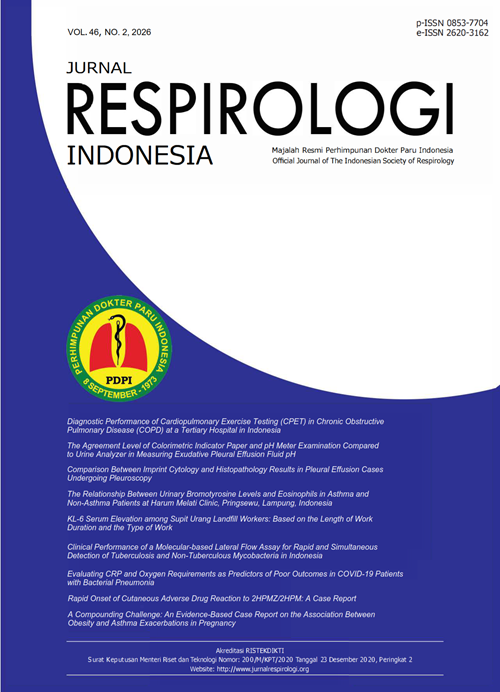
Diagnostic Performance of Cardiopulmonary Exercise Testing (CPET) in Chronic Obstructive Pulmonary Disease (COPD) at a Tertiary Hospital in Indonesia
DOI:
https://doi.org/10.36497/jri.v46i2.1078Keywords:
cardiopulmonary exercise testing, COPD, spirometry, VO2maxAbstract
Background: Chronic obstructive pulmonary disease (COPD) remains a major global health burden. Spirometry as the diagnostic gold standard, still has limitations for functional assessment. The existence of cardiopulmonary exercise testing (CPET) provides a comprehensive evaluation of integrated cardiopulmonary and metabolic responses during exercise and may improve diagnostic and management decisions in COPD. This study determined the diagnostic quality of CPET parameters for COPD.
Methods: This observational analytic cross-sectional study used paired spirometry and CPET data from medical records at Universitas Sebelas Maret Hospital. Thirty-seven eligible records were analyzed after obtaining ethics approval. CPET parameters included maximal oxygen uptake (VO2max), respiratory exchange ratio (RER), and the slope of the ratio between minute ventilation volume and carbon dioxide production volume (VE/VCO2 slope). Discrimination was assessed using AUC, diagnostic performance was assessed using the chi-square test, and correlation with obstruction severity was assessed using the GOLD classification, with a value of P<0.05 being significant.
Results: Of 37 subjects, 62.2% had COPD. COPD status was significantly associated with older age and smoking (both P<0.05). VO2max (sensitivity 73.9%; specificity 78.6%; AUC=0.795; P=0.002), RER (sensitivity 78.3%; specificity 78.6%; AUC=0.846; P=0.001), and VE/VCO2 slope (sensitivity 78.3%; specificity 71.4%; AUC=742; P=0.003) showed useful discrimination. Among CPET parameters, RER correlated significantly with obstruction severity by GOLD (P<0.05), while VO2max and VE/VCO2 slope did not (P>0.05), though trends were worse with more severe disease.
Conclusion: The integration of CPET with spirometry provides a more comprehensive approach to the diagnosis and management of COPD.
Downloads
References
1. Boers E, Barrett M, Su JG, Benjafield A V., Sinha S, Kaye L, et al. Global Burden of Chronic Obstructive Pulmonary Disease Through 2050. JAMA Netw Open. 2023;6(12):e2346598.
2. AL Wachami N, Guennouni M, Iderdar Y, Boumendil K, Arraji M, Mourajid Y, et al. Estimating the global prevalence of chronic obstructive pulmonary disease (COPD): a systematic review and meta-analysis. BMC Public Health. 2024;24(1):297.
3. Nguyen Viet N, Yunus F, Nguyen Thi Phuong A, Dao Bich V, Damayanti T, Wiyono WH, et al. The prevalence and patient characteristics of chronic obstructive pulmonary disease in non‐smokers in V ietnam and I ndonesia: An observational survey. Respirology. 2015;20(4):602–11.
4. Wang Z, Lin J, Liang L, Huang F, Yao X, Peng K, et al. Global, regional, and national burden of chronic obstructive pulmonary disease and its attributable risk factors from 1990 to 2021: an analysis for the Global Burden of Disease Study 2021. Respir Res. 2025;26(1):2.
5. Jannah W, Alfian S, Abdulah R. Identification of Psychosocial and Sociodemographic Factors Associated with Low Medication Awareness in COPD Subjects: A Cross-Sectional Study, Findings from the Indonesian Family Life Survey 5. Int J Chron Obstruct Pulmon Dis. 2025;20:1009–26.
6. Hurst JR, Siddharthan T. Global Burden of COPD. In: Handbook of Global Health. Cham: Springer International Publishing; 2021. p. 439–58.
7. Firdausi NL, Artanti KD, Li CY. Analysis of Risk Factors Affecting The Occurrence of Chronic Obstructive Pulmonary Disease in Indonesia. Jurnal Berkala Epidemiologi. 2021;9(1):18–25.
8. Salvi SS, Barnes PJ. Chronic obstructive pulmonary disease in non-smokers. The Lancet. 2009;374(9691):733–43.
9. Lu W, Aarsand R, Schotte K, Han J, Lebedeva E, Tsoy E, et al. Tobacco and COPD: presenting the World Health Organization (WHO) Tobacco Knowledge Summary. Respir Res. 2024;25(1):338.
10. Chen F, Nie Q, Han X, Li C, Liu Q, Xu F, et al. Screening of COPD patients using the COPD diagnostic questionnaire and a portable spirometer in primary healthcare institutions: a cross-sectional, diagnostic study. BMC Pulm Med. 2025;25(1):57.
11. Johns DP, Walters JAE, Walters EH. Diagnosis and early detection of COPD using spirometry. J Thorac Dis. 2014;6(11):1557–69.
12. Wang JM, Han MK, Labaki WW. Chronic obstructive pulmonary disease risk assessment tools: is one better than the others? Curr Opin Pulm Med. 2022;28(2):99–108.
13. Natali D, Cloatre G, Hovette P, Cochrane B. Screening for comorbidities in COPD. Breathe. 2020;16(1):190315.
14. Wang Z, Li Y, Lin J, Huang J, Zhang Q, Wang F, et al. Prevalence, risk factors, and mortality of COPD in young people in the USA: results from a population-based retrospective cohort. BMJ Open Respir Res. 2023;10(1):e001550.
15. Milne KM, Mitchell RA, Ferguson ON, Hind AS, Guenette JA. Sex-differences in COPD: from biological mechanisms to therapeutic considerations. Front Med (Lausanne). 2024;11:1289259.
16. Divo M, Cabrera C, Casanova C, Marin J, Pinto-Plata V, de-Torres J, et al. Comorbidity Distribution, Clinical Expression and Survival in COPD Patients with Different Body Mass Index. Chronic Obstructive Pulmonary Diseases: Journal of the COPD Foundation. 2014;1(2):229–38.
17. Laniado-Laborín R. Smoking and Chronic Obstructive Pulmonary Disease (COPD). Parallel Epidemics of the 21st Century. Int J Environ Res Public Health. 2009;6(1):209–24.
18. Kalliath A, Arun N A, Gupta N, Rose AL, Dixit R, Arora P, et al. Comparative Analysis of Cardiopulmonary Exercise Test Parameters in COPD Smokers And Healthy Smokers: Associations With 6-Minute Walk Distance and Spirometric Values. European Journal of Cardiovascular Medicine. 2024;14(5):504–9.
19. O’Donnell DE, Laveneziana P. The Clinical Importance of Dynamic Lung Hyperinflation in COPD. COPD: Journal of Chronic Obstructive Pulmonary Disease. 2006;3(4):219–32.
20. Sun XG, Hansen JE, Garatachea N, Storer TW, Wasserman K. Ventilatory Efficiency during Exercise in Healthy Subjects. Am J Respir Crit Care Med. 2002;166(11):1443–8.
21. Myers J, Arena R, Cahalin LP, Labate V, Guazzi M. Cardiopulmonary Exercise Testing in Heart Failure. Curr Probl Cardiol. 2015;40(8):322–72.
22. Salama S, Mohamed-Hussein AAR, Magdy DM, Salama A. Cardiopulmonary Exercise Testing versus Pulmonary Function Test in The Assessment of Respiratory Impairment in Chronic Obstructive Pulmonary Disease Patients. Adv Respir Med. 2022;90(3):202–10.
23. Choi HE, Min EH, Kim HK, Kim HJ, Jang HJ. Peak oxygen uptake and respiratory muscle performance in patients with chronic obstructive pulmonary disease: Clinical findings and implications. Medicine. 2022;101(42):e31244.
24. Balkissoon R, Mkorombindo T. Journal Club: Impaired Ventilatory Efficiency and Exercise Intolerance in Former/Current Smokers With Dyspnea Disproportionate to Their Lung Function: Pathophysiological Insights Gained Through Cardiopulmonary Exercise Testing. Chronic Obstructive Pulmonary Diseases: Journal of the COPD Foundation. 2022;9(3):477–85.
25. Lee B, Oh YM, Lee SW, Lee SD, Lee JS. Value of cardiopulmonary exercise testing in the assessment of symptoms and quality of life in Asian patients with chronic obstructive pulmonary disease. J Thorac Dis. 2023;15(7):3662–72.
26. Neder JA, Berton DC, Müller P de T, Elbehairy AF, Rocha A, Palange P, et al. Ventilatory Inefficiency and Exertional Dyspnea in Early Chronic Obstructive Pulmonary Disease. Ann Am Thorac Soc. 2017;14(Supplement_1):S22–9.
27. Solberg G, Robstad B, Skjønsberg OH, Borchsenius F. Respiratory gas exchange indices for estimating the anaerobic threshold. J Sports Sci Med. 2005;4(1):29–36.
28. Yanagi H, Miki K, Koyama K, Miyamoto S, Mihashi Y, Nagata Y, et al. Gas exchange efficiency slopes to assess exercise tolerance in chronic obstructive pulmonary disease. BMC Pulm Med. 2024;24(1):550.
Downloads
Published
Issue
Section
License
Copyright (c) 2026 Musdalifah, Hendrastutik Apriningsih, A. Farih Raharjo

This work is licensed under a Creative Commons Attribution-ShareAlike 4.0 International License.
- The authors own the copyright of published articles. Nevertheless, Jurnal Respirologi Indonesia has the first-to-publish license for the publication material.
- Jurnal Respirologi Indonesia has the right to archive, change the format and republish published articles by presenting the authors’ names.
- Articles are published electronically for open access and online for educational, research, and archiving purposes. Jurnal Respirologi Indonesia is not responsible for any copyright issues that might emerge from using any article except for the previous three purposes.