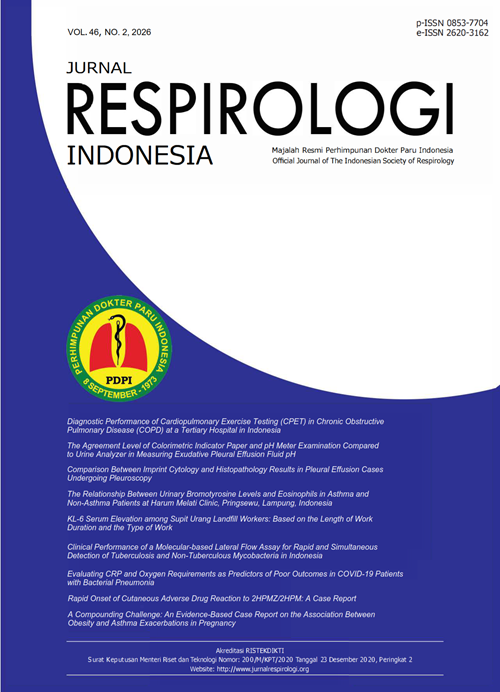
KL-6 Serum Elevation among Supit Urang Landfill Workers: Based on the Length of Work Duration and the Type of Work
DOI:
https://doi.org/10.36497/jri.v46i2.1095Keywords:
duration of exposure, KL-6 serum, Supit Urang Landfill, waste workers, work typeAbstract
Background: Waste workers at the Supit Urang Landfill, Malang, Indonesia, are exposed to occupational inhalation hazards, including bacterial bioaerosols, VOCs, CH4, CO, and H2S. Chronic exposure to these agents may induce alveolar epithelial injury and inflammatory responses, potentially leading to increased serum Krebs von den Lungen-6 (KL-6) levels. KL-6 itself is a glycoprotein biomarker associated with lung epithelial injury and inflammation. Therefore, this study was conducted to analyze serum KL-6 levels in relation to occupational exposure duration and type of work.
Methods: This analytical observational study used a cross-sectional design. A total of 79 workers were categorized based on exposure duration (<5 years, 5–10 years, >10 years) and type of work (scavengers, waste sorters, waste processors, laboratory technicians). Measurement of serum KL-6 levels used ELISA. Then, group differences were analyzed using the Kruskal–Wallis test.
Results: KL-6 serum levels were higher among workers with >10 years of exposure (1170.3±621.4 U/mL) compared to the other groups (P=0.0001). KL-6 levels differed significantly across job types (P=0.402), with higher levels observed among scavengers (1049.6±586.6 U/mL).
Conclusion: Serum KL-6 levels were associated with job type and showed a rising trend with longer exposure duration, particularly among workers with more than 10 years of occupational exposure.
Downloads
References
1. Kaza S, Yao LC, Bhada-Tata P, Van Woerden F, Levine D. What a Waste 2.0: A Global Snapshot of Solid Waste Management to 2050. Washington, DC: World Bank; 2018.
2. Vinti G, Bauza V, Clasen T, Medlicott K, Tudor T, Zurbrügg C, et al. Municipal Solid Waste Management and Adverse Health Outcomes: A Systematic Review. Int J Environ Res Public Health. 2021;18(8):4331.
3. WHO. WHO [Internet]. 2024 [cited 2026 Jun 12]. Health-care waste. Available from: https://www.who.int/news-room/fact-sheets/detail/health-care-waste
4. Jiang D, Xiao H, Dong R, Geng J, Xie B, Ren Y, et al. Krebs von den Lungen‐6 levels in untreated idiopathic pulmonary fibrosis. Clin Respir J. 2022;16(3):234–43.
5. Lee YG, Lee PH, Choi SM, An MH, Jang AS. Effects of Air Pollutants on Airway Diseases. Int J Environ Res Public Health. 2021;18(18):9905.
6. Poole CJM, Basu S. Systematic Review: Occupational illness in the waste and recycling sector. Occup Med (Chic Ill). 2017;67(8):626–36.
7. Gao Y, Du T, Yang L, Wu L. Research progress of KL-6 in respiratory system diseases. Crit Rev Clin Lab Sci. 2024;61(7):599–615.
8. He R, Huang L, Chen Y, Liu M, Xie M, Yuan H, et al. Serum KL-6 combined with immune/inflammatory biomarkers identifies complicated silicosis. BMC Pulm Med. 2026;26:43.
9. Liu J, Zhang R, Song HY, Xia Q, Zhao TT, Pan LP, et al. The effects of long-term exposure to silica dust on serum CC16 and KL-6 levels. Zhonghua Lao Dong Wei Sheng Zhi Ye Bing Za Zhi. 2019;37(8):567–70.
10. Wibawa WAAS, Lusno MFD. Environmental health risk analysis of Hydrogen Sulfide (H2S) exposure to Jabon Sidoarjo landfill scavengers. World Journal of Advanced Research and Reviews. 2023;18(3):1463–8.
11. Mortazavi S, Makouei S, Abbasian K, Danishvar S. Exhaled Breath Analysis (EBA): A Comprehensive Review of Non-Invasive Diagnostic Techniques for Disease Detection. Photonics. 2025;12(9):848.
12. van der Schee MP, Paff T, Brinkman P, van Aalderen WMC, Haarman EG, Sterk PJ. Breathomics in Lung Disease. Chest. 2015;147(1):224–31.
13. Salthammer T. Carbon monoxide as an indicator of indoor air quality. Environmental Science: Atmospheres. 2024;4(3):291–305.
14. Sun J, Xu Q. Body mass index and the outcome of acute respiratory distress syndrome, what is their relationship and why? Clin Respir J. 2023;17(3):251–2.
15. Zahorec R. Neutrophil-to-lymphocyte ratio, past, present and future perspectives. Bratislava Medical Journal. 2021;122(07):474–88.
16. Sharma M, Jain N, Sinha N, Kaushik R, Jash D, Chaudhry A. Diagnostic and Prognostic Role of Neutrophil-to-Lymphocyte Ratio in Early and Late Phase of Sepsis. Indian Journal of Critical Care Medicine. 2018;22(9):660–3.
17. Firmansyah ZZ, Astuti TW, Duta GA. Increased Serum KL-6/MUC1 Level, Neutrophils and Lymphocytes Sputum in Malang Splendid Bird Market Workers. Jurnal Respirologi Indonesia. 2020;40(2):75–81.
18. Faruque MdO, Vonk JM, Bültmann U, Boezen HM. Airborne occupational exposures and inflammatory biomarkers in the Lifelines cohort study. Occup Environ Med. 2021;78(2):82–5.
19. Cao X, Hu S, Xu D, Li M, Wang Q, Hou Y, et al. Serum levels of Krebs von den Lungen‐6 as a promising marker for predicting occurrence and deterioration of systemic sclerosis‐associated interstitial lung disease from a Chinese cohort. Int J Rheum Dis. 2019;22(1):108–15.
20. Shigemura M, Konno S, Nasuhara Y, Shijubo N, Shimizu C, Nishimura M. Serum KL-6 concentrations are associated with molecular sizes and efflux behavior of KL-6/MUC1 in healthy subjects. Clinica Chimica Acta. 2013;424:148–52.
21. Njoku PO, Edokpayi JN, Odiyo JO. Health and Environmental Risks of Residents Living Close to a Landfill: A Case Study of Thohoyandou Landfill, Limpopo Province, South Africa. Int J Environ Res Public Health. 2019;16(12):2125.
22. Hidayatullah F, Mulasari SA. Literature Review: Gangguan Saluran Penapasan Akibat Pencemaran Udara di Lingkungan Tempat Pembuangan Akhir (TPA). Jurnal Kesehatan. 2020;13(2):119–30.
23. Căluțu IM, Smărăndescu RA, Rașcu A. Biomonitoring Exposure and Early Diagnosis in Silicosis: A Comprehensive Review of the Current Literature. Biomedicines. 2022;11(1):100.
24. Maradjabessy FA, Yuniarti Y, Adji HW. Scoping Review: Efek Debu terhadap Fungsi Paru Pekerja. Jurnal Integrasi Kesehatan & Sains. 2021;3(1):80–5.
25. Hossain MdA, Zaman SU, Roy S, Islam MdS, Zerin I, Salam A. Emission of particulate and gaseous air pollutants from municipal solid waste in Dhaka City, Bangladesh. J Mater Cycles Waste Manag. 2024;26:552–61.
26. Hidayati RM, Utomo SW, Kusnoputranto H. Health Risks of People Living Close Cipayung Depok Landfill Due to Hydrogen Sulfide Exposure: Respiratory Problems and Malodor Peceptions. Indian J Public Health Res Dev. 2020;11(3):1048–53.
27. Heldal KK, Halstensen AS, Thorn J, Djupesland P, Wouters I, Eduard W, et al. Upper airway inflammation in waste handlers exposed to bioaerosols. Occup Environ Med. 2003;60(6):444–50.
28. Dini Z, Astuti TW, Tantular R. Serum Protein D Surfactant Level Based on Length of Exposure in Workers at the Supit Urang Waste Disposal Site, Malang. Medica Hospitalia : Journal of Clinical Medicine. 2025;12(1):9–22.
29. Monaco MGL, Mattiello A, Muoio M, Uccello R, Chiodini P, Panico S. The health effects of working in waste disposal incinerators and landfill: a systematic review. ISEE Conference Abstracts. 2016;2016(1).
30. Tlotleng N, Kootbodien T, Wilson K, Made F, Mathee A, Ntlebi V, et al. Prevalence of Respiratory Health Symptoms among Landfill Waste Recyclers in the City of Johannesburg, South Africa. Int J Environ Res Public Health. 2019;16(21):4277.
Downloads
Published
Issue
Section
License
Copyright (c) 2026 Rizki Diah Anggraeni, Tri Wahju Astuti, Fitri Indah Sari, Sastia Rakhma

This work is licensed under a Creative Commons Attribution-ShareAlike 4.0 International License.
- The authors own the copyright of published articles. Nevertheless, Jurnal Respirologi Indonesia has the first-to-publish license for the publication material.
- Jurnal Respirologi Indonesia has the right to archive, change the format and republish published articles by presenting the authors’ names.
- Articles are published electronically for open access and online for educational, research, and archiving purposes. Jurnal Respirologi Indonesia is not responsible for any copyright issues that might emerge from using any article except for the previous three purposes.